Learn
Sea vegetables in the kitchen: a pantry guide and how to cook seaweed
What sea vegetables are and why to keep them in your pantry
Sea vegetables are a food from the ocean that supplies trace elements, vitamins and minerals such as magnesium, zinc, calcium and manganese. In Nutrición energética y salud, Dr. Jorge Pérez-Calvo recommends them as a simple way to add these minerals to the table, especially today, when intensive farming depletes the soil.
The advice is to eat a small amount regularly. Large portions are not needed: even a little seaweed brings flavour and nutritional value to everyday dishes.
They also have a quality that is very useful in cooking: they are cooling. That is why they sit well in summer dishes and, unlike fruit —which cools but provides fewer minerals—, they are a good way to take those minerals in.
Where they come from: a European tradition too
We tend to associate seaweed with Japanese cooking, but it is no stranger to our own table. In Brittany, in Ireland, in Valencia or on the Costa Brava, dishes with seaweed have always been made.
From Japan we have inherited some very recognisable uses, such as brown rice balls wrapped in nori seaweed with an umeboshi plum in the centre. It is a simple bite that you can prepare at home.
Make the rice balls with umeboshi and nori seaweed: Rice Balls with Umeboshi and Nori →
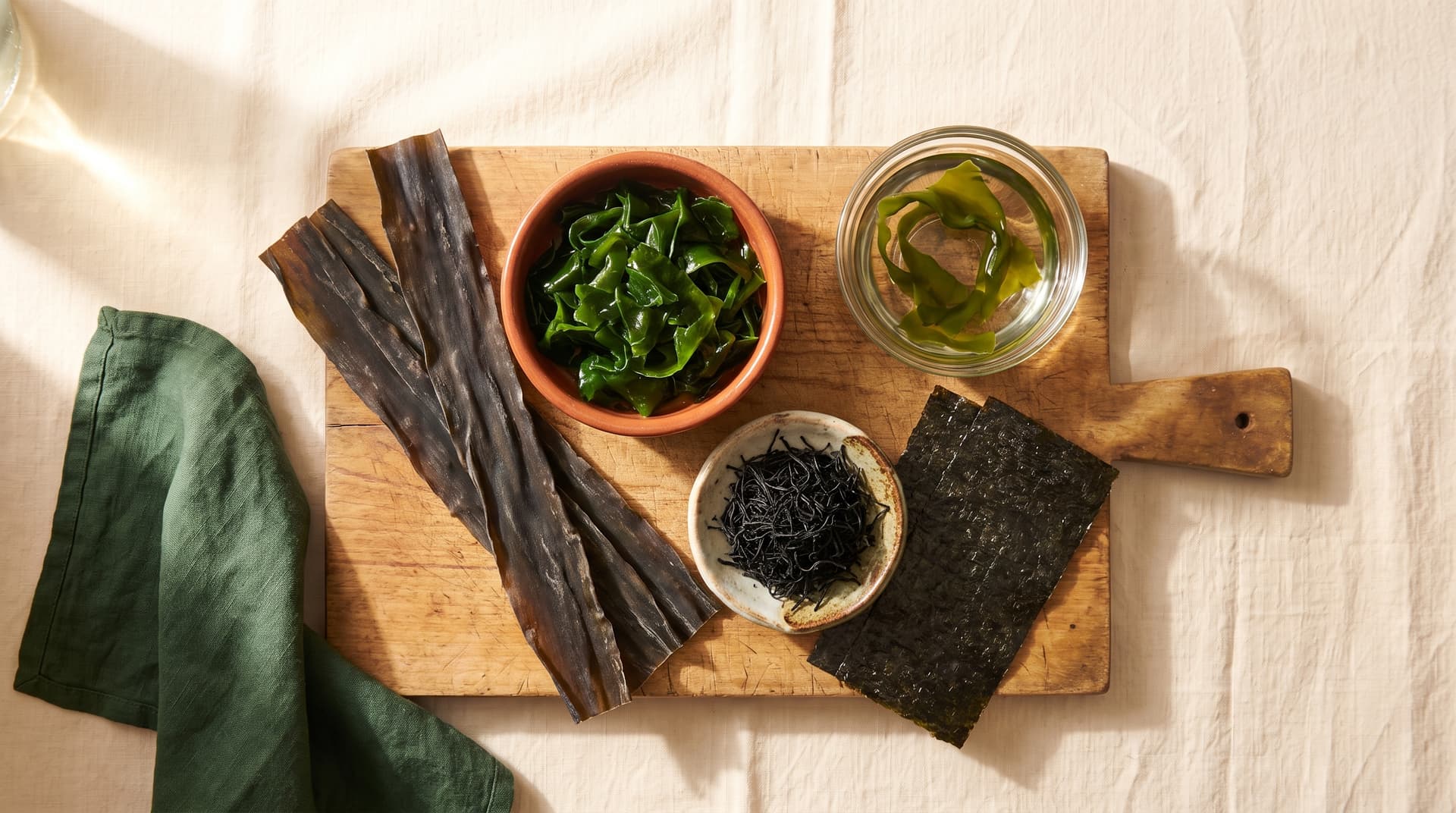
The seaweed in your pantry, one by one
Kombu. It goes with rice and pulses and gives body to broths and stews. It cooks together with the grain or the pulse: simply place it at the bottom of the pot and set the grain or the legume on top. It needs at least an hour of cooking to turn nicely tender; it remineralises the dish and adds flavour. Nutrición energética y salud describes it as the "bone" of a lentil or rice stew, with a guideline amount of around 6 cm² a day.
Wakame. It cooks very briefly, one to four minutes, and is used above all in soups. When soaked it triples in volume, so a little goes a long way; well soaked, it can also be eaten raw in a salad.
Hijiki. It is the richest in calcium. After soaking, it cooks for about three quarters of an hour with a little water; it pairs very well with onion and carrot and is seasoned with a touch of shoyu.
Arame. Short and flexible cooking time: between five and twenty minutes. It can also simply be eaten soaked.
Nori. Rich in vitamin A, you can eat it toasted or boil it for two or three minutes, until it becomes creamy. When you toast it by hand over the flame it turns from black to green: that is the sign it is ready.
Agar-agar. Very cooling and ideal for summer. It is combined with fruit and vegetables in flans and jellies, and also, once soaked, in salads.
How to use them in everyday cooking
With grains. Adding kombu while the grain cooks brings out its flavour and adds nutritional value. There is also no need to add salt, because the kombu releases its mineral salts; that is why it is worth cooking grain with kombu on a regular basis.
With pulses. To round off a dish of pulses it helps to serve them with seaweed and toasted sesame, and instead of a lot of oil, with onion and carrot. Azuki beans, for example, go well with arame, hijiki or kombu. Another simple gesture: season them with a pinch of soy sauce and cook them with kombu.
In soups and broths. Seaweed is added in small amounts to soups, or serves as the base for a broth. Wakame is the classic companion to miso.
As a seasoning. A practical idea is homemade seaweed powder: toast kombu or wakame in the oven until brittle, grind them in a mortar and sprinkle them over the dish, on their own or mixed with sesame or pumpkin seeds. There is also goma-wakame, a sea version of gomashio.
To add the salty note. When cooking, seaweed brings a salty flavour with less sodium; among those with a salty taste are kelp, kombu and dulse.
Which recipes in the catalogue feature seaweed
In the catalogue, seaweed appears both as the star and in its more usual supporting role. Arame seaweed is sautéed with onion and carrot in sesame oil.
Hijiki has its own base cooking method, with soaking, boiling and braising with sesame, rice vinegar and shoyu: a good starting point for getting to know this seaweed.
And agar-agar gives body to fresh desserts and jellies. The fruit flan, set with agar-agar and kuzu, is a good example for summer.
Discover arame seaweed with onion and carrot: Arame with Onion and Carrot →
Make a fruit flan with agar-agar and kuzu: Fruit Kanten with Agar-agar and Kuzu →
Frequently asked questions about cooking with seaweed
How long does each seaweed cook for? It depends on the type. Wakame needs very little (one to four minutes); nori, two or three; arame, five to twenty; hijiki, about three quarters of an hour; and kombu, at least an hour, until nicely tender.
How much should you use? A little. As a guide, about 6 cm² of kombu a day is enough. Wakame triples in volume when soaked, so a pinch is enough.
Do you need to add salt if you cook with kombu? It is usually not necessary: when the grain cooks with kombu, the seaweed releases its mineral salts and salts the dish by itself.
Can they be eaten raw? Some can. Wakame, well soaked, is eaten in salad; soaked agar-agar too, and arame can be eaten simply soaked.
Which ones are good in summer? They are all cooling, and agar-agar is ideal for warm-season jellies and flans.