Learn
Umeboshi (Japanese Pickled Plum): What It Is, Its Culinary Properties and How to Use It
What umeboshi is
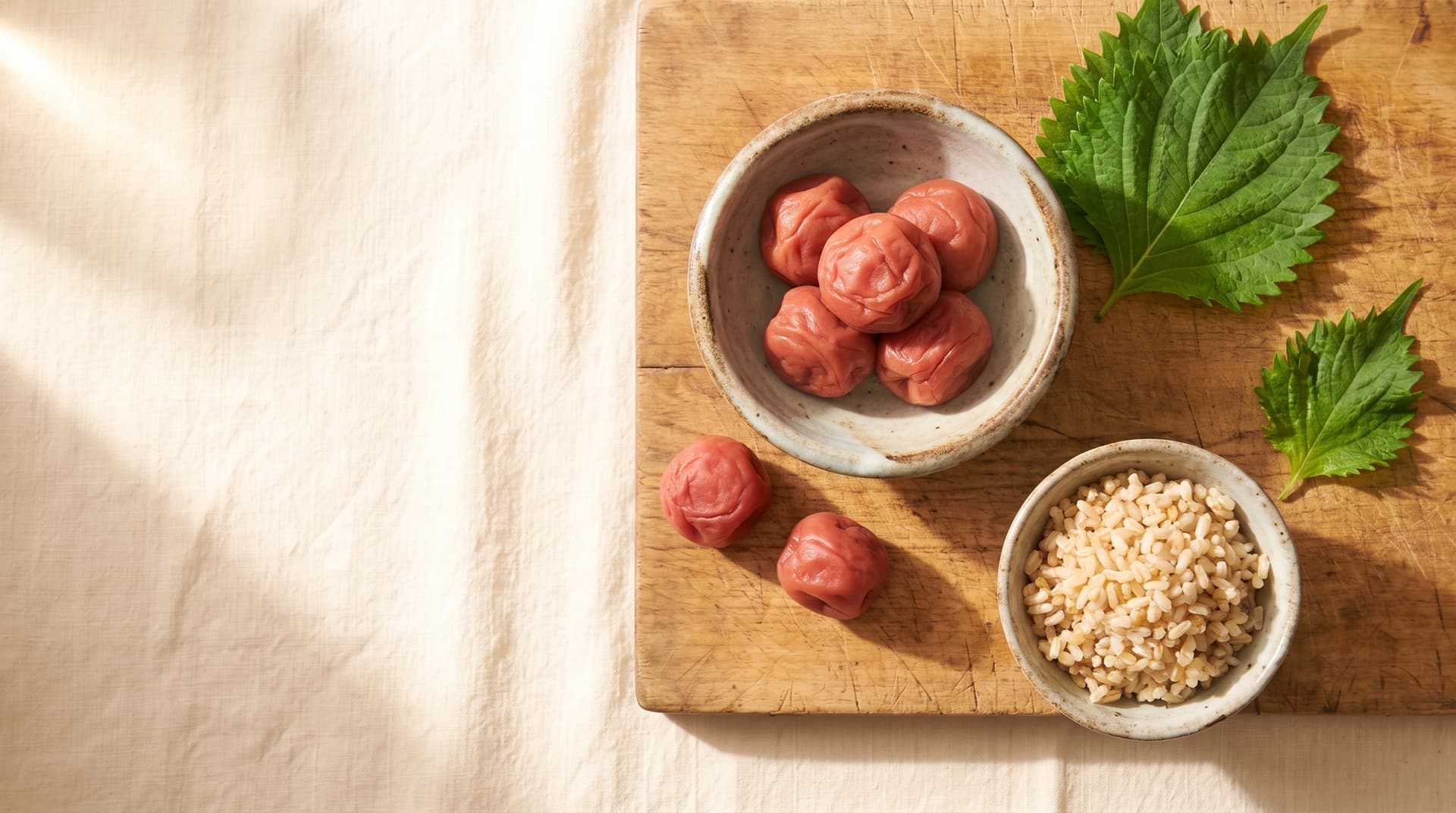
Umeboshi is one of those small pantry items that give a great deal in return for very little. It is a pickled Japanese plum whose name means, precisely, "salted plum".
As Dr. Pérez-Calvo explains in Nutrición energética y salud, it is a long-keeping pickle made by macerating the plum in salt for a long time, sometimes two years or more. Hence its remarkably intense flavour and its markedly yang character.
The author records the same point in Revitalízate: a salted Japanese plum, cured in salt for two years or more, eaten in minimal amounts —on its own, cooked with grains, or dissolved with kuzu. That it appears in two of his books makes clear this is no incidental ingredient, but a classic of this style of cooking.
Where it comes from: the salted plum of Japanese tradition
Umeboshi comes from traditional Japanese cooking, where it has been used for generations as a preserving condiment.
One of its most recognisable presentations is a small snack: the plum tucked inside a ball of brown rice and wrapped in nori seaweed. This is how Dr. Pérez-Calvo describes it in Nutrición energética y salud when he reviews its uses in the kitchen.
In Comer, sentir, vivir the author also mentions ume as a "Japanese plum extract", alongside other pickles obtained by natural fermentation, without vinegar or sugar, such as sauerkraut.
Umeboshi's culinary properties: between salty and sour
When we speak of umeboshi's properties, it helps to understand them in culinary terms: its flavour, its character and the way it combines in a dish.
On the one hand, it belongs to the group of salty foods. In Nutrición energética y salud, Dr. Pérez-Calvo places it among the products that carry a good dose of salt, such as soy sauce, miso, gomashio and pickles.
On the other, it is also a quality sour flavour. The author sets the ume plum among the finest sour foods in the pantry —organic lemon, rice vinegar and pickles— in a category that Revitalízate describes as "sour and salty".
In its section on pickles, Nutrición energética y salud describes it as very rich in mineral salts and satiating, which explains why a very small amount is enough to give character to a dish.
How it is used and how to take it in cooking
The golden rule with umeboshi is restraint: it is always used in very small amounts.
In Nutrición energética y salud, Dr. Pérez-Calvo suggests something like a third of a plum a day. He specifies that, per meal and per person, the portion can range from a fifth of a plum to a whole one, depending on its size.
In practice, umeboshi stands in for salt in soups and sauces. It is also eaten on its own, cooked with grains, or dissolved with kuzu.
Very convenient to handle is its vinegar. Umeboshi vinegar features in the author's recommended pantry, alongside rice, apple and unrefined wine vinegars, and serves both to marinate vegetables and to season. A cooking note recorded in Revitalízate: when cooking with umeboshi vinegar it is wise to add little salt at the start, since the vinegar itself already brings plenty of saltiness.
A simple way to start: toasted sunflower, pumpkin or sesame seeds can be seasoned with a few drops of umeboshi vinegar, as indicated in Nutrición energética y salud.
Which recipes in the collection feature umeboshi
In the recipe collection, umeboshi appears in two forms: as the plum (or its paste) and as vinegar.
As the plum, it stars in the rice balls with umeboshi and nori seaweed, where it is set into the hollow centre of the ball before it is wrapped in nori. Its paste also fills the cucumber-and-umeboshi maki among the brown rice makis.
That same paste is pounded with sesame paste, rice vinegar and water to make the vinaigrette that dresses the blanched-vegetable salad while still warm. And for breakfast, the umeboshi plum is one of the options for bringing a touch of salt to grain porridges, as an alternative to sea salt or kombu seaweed: so it is in the brown rice porridge and in several oat porridges.
The vinegar, for its part, marinates the radishes and cucumber in the summer quinoa salad, accompanies the Milanese-style breaded seitan with thinly sliced radishes, and gives the sour note to the creamy tofu sauce.
The recipe for the cucumber-and-umeboshi makis is in the recipe collection.: Brown Rice Maki Rolls →
Frequently asked questions about umeboshi in cooking
How much umeboshi should you take? Very little. As we have seen, Dr. Pérez-Calvo speaks of around a third of a plum a day, and of portions ranging from a fifth of a plum to a whole one per meal, depending on its size.
Why is it so salty? Because it is made by a very long fermentation in salt, of two years or more. That salt is what gives it its characteristic flavour and its long keeping.
Plum or umeboshi vinegar? It will depend on the dish: the plum or its paste for fillings, soups and pounded sauces; the vinegar for marinating vegetables and dressing. Remember to salt lightly when you cook with the vinegar.
What does it go with? In this cuisine it is paired with grains, with seaweeds and toasted seeds, and with kuzu. In fact, in Comer, sentir, vivir it is grouped among the condiments, alongside seaweeds and seeds.