Learn
Miso: what it is, the types of miso paste and how to use it in cooking
What miso is
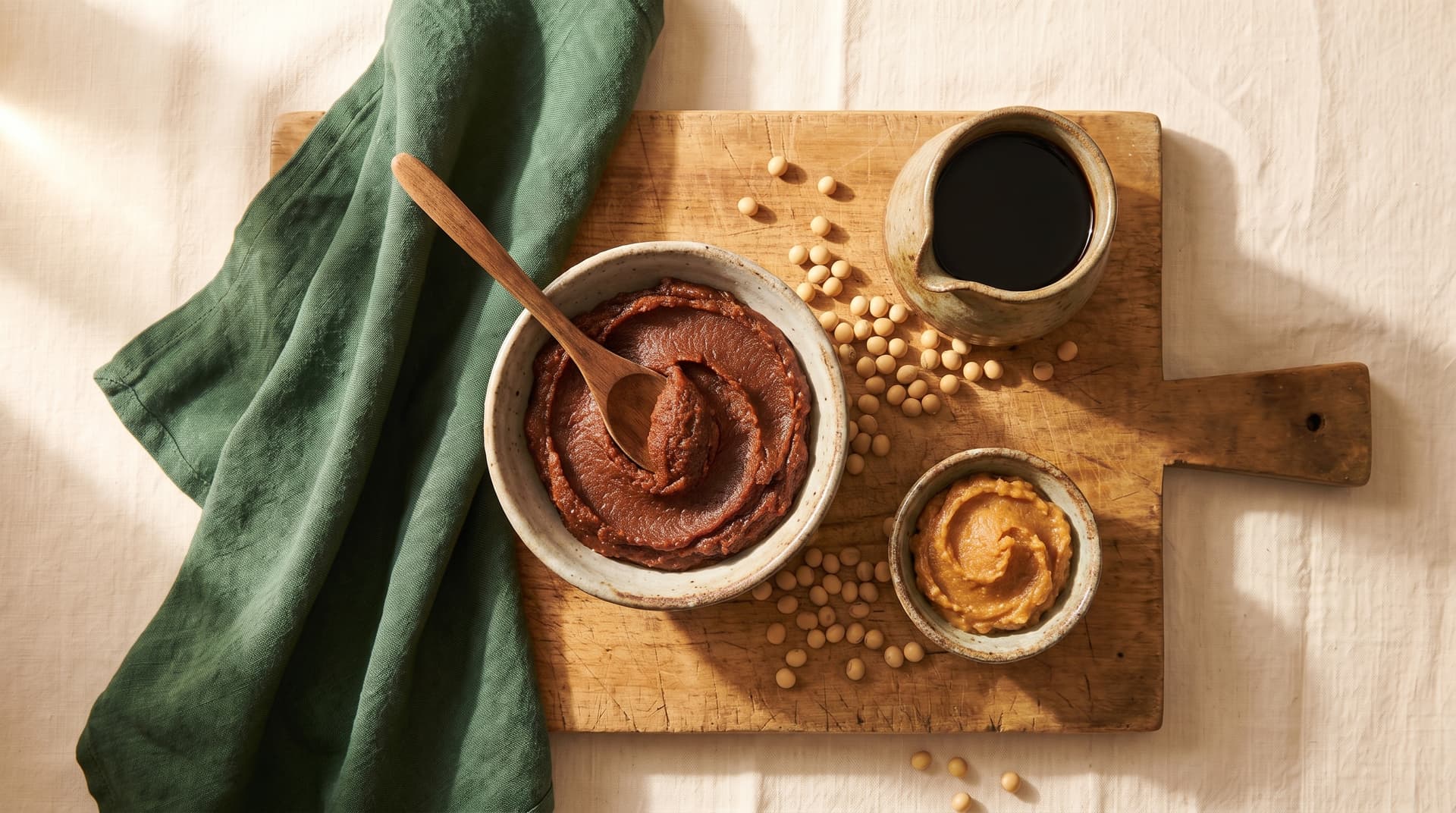
Miso is an intensely flavoured paste used as a seasoning, and very little of it is needed to transform a broth or a sauce. It is made by fermenting soy, which is why it belongs to the family of fermented soy foods.
As Dr. Pérez-Calvo notes in Nutrición energética y salud, there are pure soy misos and misos combined with a grain — rice, barley or buckwheat. Among them all, the author points to his preference for the barley one, known as mugi miso.
Miso sits among the condiments: strongly flavoured, almost always salty preparations that join a plant product with salt, so that the plant softens and rounds off that salt. In that group it is joined by tamari and shoyu, likewise born of the fermentation of soy.
Where it comes from and how it is made
Miso is born of a fermentation process. It starts from soy — on its own or together with the chosen grain — and is left to ferment until it reaches that dense, savoury paste.
When buying it, one detail is worth watching for: that it be naturally fermented and not pasteurised. This way it keeps its ferments alive, and they are precisely what one seeks to respect when cooking it, as we shall see in a moment.
In the recipe collection, a good many of the recipes call for barley or rice miso, always unpasteurised; some sauces also use white miso.
The key gesture: don't let it boil
If one had to keep a single idea about miso, it would be this: it must not boil. Its culinary virtue lies in the living ferments, and boiling would ruin them.
Dr. Pérez-Calvo explains it clearly in Nutrición energética y salud: the paste is dissolved in the broth — about half a teaspoon per cup or plate is enough — and added at the end, over very gentle heat, without letting the broth come to a boil. It is best used in small amounts and on a regular basis.
That same gesture reappears when cooking pulses: when the miso or the soy sauce is added at the end, two or three minutes of gentle simmering are enough, without letting them boil. The author adds another practical note: it is best not to add salty seasonings at the start of cooking pulses, as they would end up toughening the grain.
Tamari and shoyu: soy's liquid cousins
Alongside miso live two liquid soy sauces that share its very same logic of use: tamari and shoyu.
Dr. Pérez-Calvo describes tamari as the sauce that results from fermenting soy, savoury and rich in amino acids; shoyu would be a somewhat more diluted, less salty tamari, easier to handle day to day.
The kitchen rule is common to all three: they are added at the end of cooking and are not used raw. If used cold, the author suggests softening them with a touch of lemon, of oil or of another acidic or fatty ingredient, or else 'taming' them with a little wasabi, Japanese mustard or ginger. They go well with vegetables, pulses, sauces and soups, but they are not poured directly over rice or grain.
The author himself sums it up in his recommendations: salt, tamari and shoyu are put to better use cooked than raw, always added during cooking and not once on the plate. Shoyu, being lighter, is reserved for the more delicate dishes and cooking.
In which recipes of the collection miso appears
In the recipe collection, miso plays several roles: it stars in soups and sauces, lends a background aroma and serves to marinate.
It stars, of course, in the miso soup with wakame, where it is dissolved and added at the end without boiling. And it gives its name to the whole onions with miso, in which the paste is spread through the star-shaped cuts in the onions before cooking them. In sauce form it appears in the miso sauces: one series bound with tahini in the suribachi — miso and lemon, miso and orange, miso and ginger — and another with toasted sesame oil, walnuts or almonds.
As a background aroma, a few spoonfuls of barley miso join the seasonings of the red lentil pâté. And as a marinade it shines in the tofu cheese: a block of tofu is coated in barley miso, rests for a day in the fridge and is then rinsed to be served in thin slices. That same play, now with tamari or shoyu, prepares the griddled marinated tofu.
It even appears in seasonal versions, such as the minestrone soup with millet and chickpeas, whose winter variant allows a little barley miso dissolved at the end.
Frequently asked questions about miso in cooking
Can miso be boiled? It is best not to. It is dissolved and added at the end, and kept over the lowest heat without letting it come to a boil, to preserve its living ferments.
How much miso per serving? Very little. Dr. Pérez-Calvo speaks of about half a teaspoon per cup or bowl, just enough for it to be savoury without being overly salty.
Can miso soup be had every day? Yes, as long as it stays mild. The author notes that in summer the miso may be swapped for a naturally fermented soy sauce, or the two alternated.
Is miso good for anything besides soups? Yes. It marinates tofu, as in the tofu cheese, and it also pickles: pickles, which are vegetables fermented with salt, likewise take miso instead of salt.
White miso or barley miso? For general use, the author leans towards the barley one (mugi miso), and in the recipe collection the unpasteurised kind is chosen too.