Learn
Kuzu root: its properties in cooking, where it comes from and how to use it
What is kuzu?
If you have come here looking for the properties of kuzu, it is worth starting with the essentials: above all, it is a cooking ingredient. A natural thickener with a long history behind it.
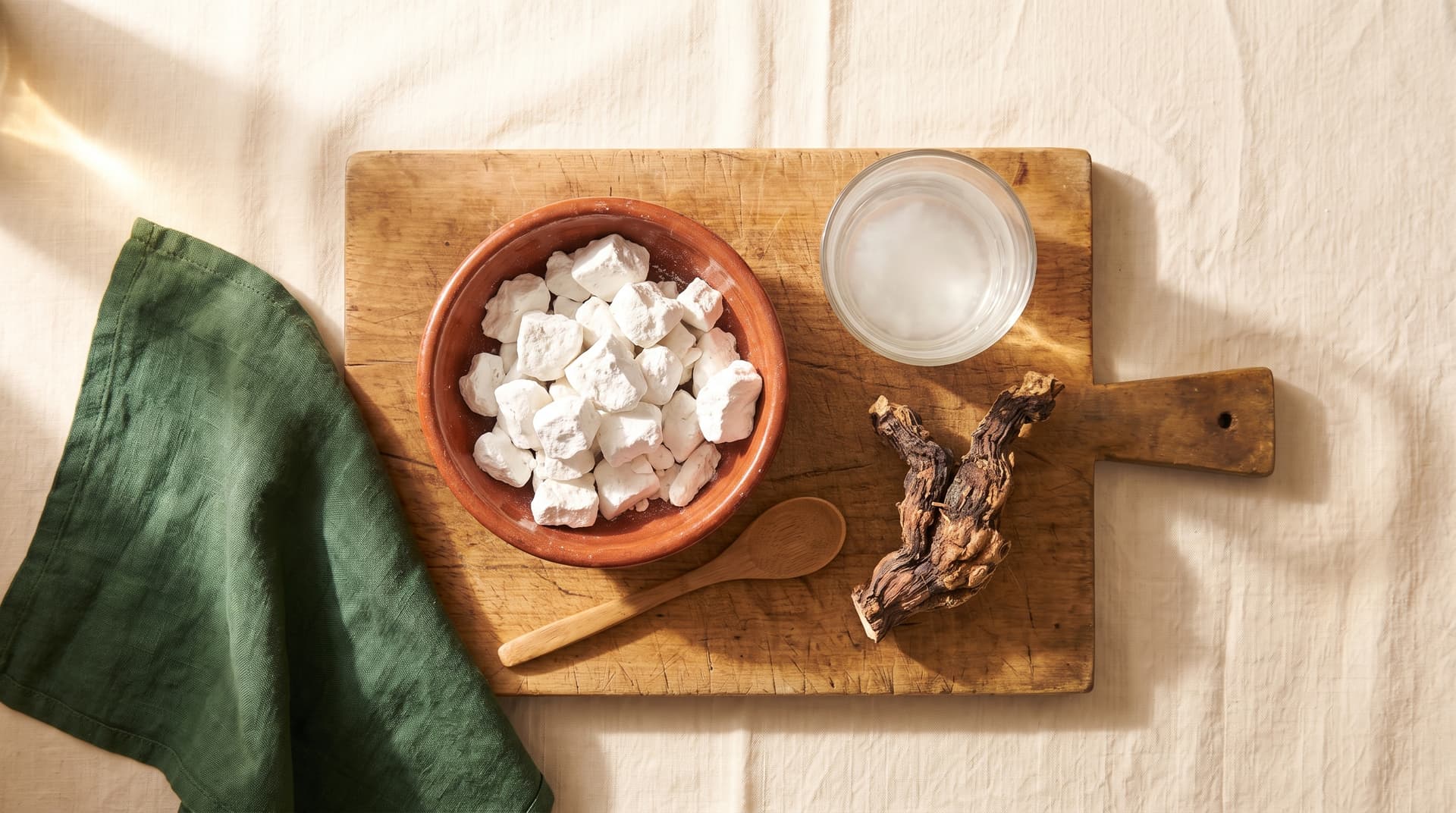
Kuzu is the white starch obtained from the root of Pueraria hirsuta. As Dr. Pérez-Calvo explains in Nutrición energética y salud, it is a bulky root that sinks deep into the earth, and it is from this root that the starch is extracted. In health-food shops you will find it in exactly that form: a white powder.
In the tradition of energy-based cooking, kuzu is classed as a strongly 'yang' food, sweet in flavour with an astringent edge, as noted in both Nutrición energética y salud and Comer, sentir... vivir. It is also a low-fat food that leaves little residue, belonging to the same culinary family as millet, brown rice, seaweed and miso soup.
Where does kuzu come from?
Behind that unassuming powder lies a remarkable plant. In ¡Revitalízate!, Dr. Pérez-Calvo describes it as a perennial climber that winds around trees to gain height, with an enormous root that can match the size of a person.
It seeks out shade: it thrives in the mountains and in the less sunlit fields, along the edges of paths and among scrubland and sparse groves, in China as much as in the south-east of the United States. There is also a second Asian species, Pueraria thomsonii.
The journey from field to pantry is a craft. The roots are gathered in winter and undergo a long process in which the starch is separated from the rest of the plant, dried and ground to a powder. In the energy-cooking pantry it is kept among the 'specific products', alongside umeboshi, lotus-root powder and dried daikon, and it is bought in health-food shops.
What is kuzu used for in cooking?
In the kitchen, kuzu performs one very specific task: to thicken and to gel. As Dr. Pérez-Calvo explains in ¡Revitalízate!, it replaces other flours when preparing soups, purées, sauces, puddings or tart fillings, and it can even be added to salad dressings, since its flavour hardly clashes with any ingredient.
That gelling power makes it very useful with fruit. In Nutrición energética y salud, the author suggests it — together with agar-agar, cinnamon, ginger or organic lemon peel — as a way of cooking and dressing fruit rather than eating it raw, using it to achieve a kind of soft jelly.
Of its composition, ¡Revitalízate! highlights two things: carbohydrates, which the body uses as a source of energy, and fibre.
The full recipe, step by step, is in the recipe collection: Fruit Kanten with Agar-agar and Kuzu →
How to use kuzu: the knack of dissolving and cooking it
The secret to using kuzu well is never to add it straight into a hot dish. First, dissolve it in a little cold liquid — water, plant milk or juice — until it takes on a gelatinous, almost transparent texture.
Then it is stirred into the dish and stirred continuously, over medium or low heat, until the mixture thickens and turns transparent. That shift to transparency is the sign that the kuzu has done its work.
The amounts depend on the body you are after: in the recipe collection they range from half a teaspoon for a light glaze to two or three tablespoons for a firmer filling or custard. And should you want an even thicker sauce, simply add a little more dissolved kuzu.
Which recipes in the collection use kuzu
In savoury dishes, kuzu is above all a binder for sauces. It gives body to the sauce for tofu with prawns, binds the mushroom sauce of the seitan and thickens the broth of the whole onions with miso. It also lends body to the vegetable wok. And in the breaded Milanese-style seitan it plays a different role: that of the 'glue' for the coating, in place of egg.
In desserts it reveals its gelling side. It gives both name and body to the ginger pears with kuzu and molasses sauce, lends consistency to the fruit custard with agar-agar and kuzu, glazes the steamed cherries and thickens the strawberry-and-coconut mousse, the apple compote with cinnamon and almonds, the soft oat-and-apple tart and the grain-coffee cream with agar-agar.
See the coating trick, on video: Breaded Seitan Milanese →
The full recipe is in the recipe collection: Pears with Ginger in Kuzu and Rice Syrup Sauce →
The classic kuzu preparations
Finally, there is a small group of preparations in which kuzu is the star rather than a mere thickener. They are three classics of energy cooking: Ume-Sho-Kuzu (kuzu, umeboshi plum and tamari), kuzu with apple juice, and kuzu with rice molasses.
In all of them the same gesture you now know is repeated: dissolve a tablespoon of kuzu in cold liquid — in water, in apple juice or in water with molasses — and cook, stirring without stopping, until the mixture thickens and turns transparent. They are taken hot or warm.
See how they are made, step by step: Traditional Preparations I →