Learn
Kuzu root and umeboshi (pickled plum): what ume-sho-kuzu is and how to make it
What kuzu and umeboshi are
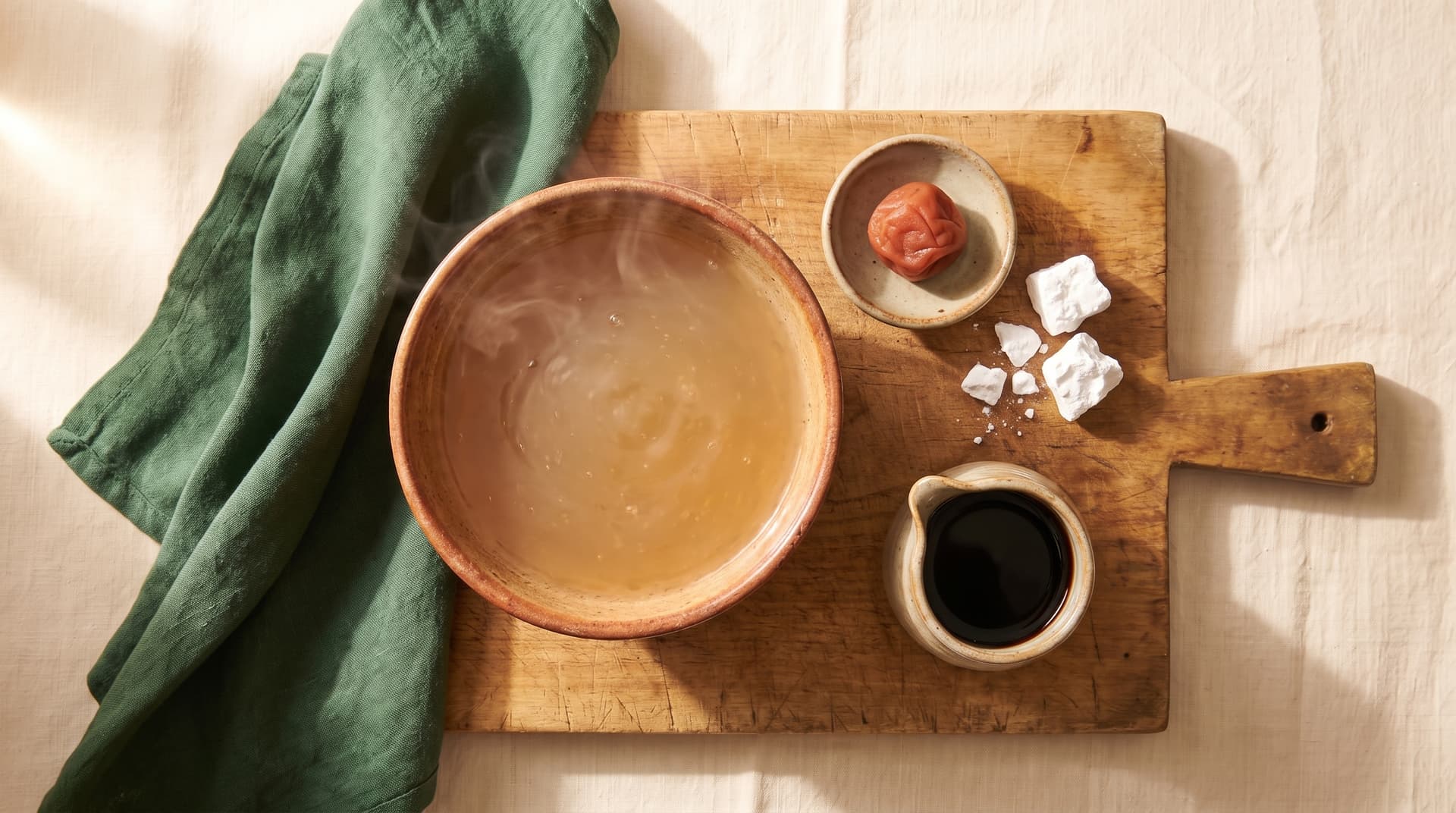
In energetic nutrition cooking, kuzu and the umeboshi plum are a regular pairing in Dr. Pérez-Calvo's recipe book. Together they give rise to ume-sho-kuzu, a warm, thick preparation that brings together three ingredients from the traditional pantry. Before looking at how it is made, it helps to know what each one is.
Kuzu is obtained from the root of Pueraria hirsuta. As Dr. Pérez-Calvo notes in Nutrición energética y salud, it reaches the health-food shop in the form of a white starch. It is, therefore, a plant-based thickener: a powder that, once dissolved and heated, gives body to liquids and sets them into a gel.
Umeboshi is a Japanese plum; its name means, precisely, 'salted plum'. As the author explains in the same book, it is a long-keeping pickle, cured in salt for two years or more, a process that makes it very salty and markedly yang in character. For that reason it is always taken in very small amounts, on its own, cooked with grains, or alongside kuzu.
The name ume-sho-kuzu itself brings together the three elements of the preparation: ume (the umeboshi plum), sho (the shoyu or tamari) and kuzu. It is no coincidence that they go together: in his pantry list, Dr. Pérez-Calvo catalogues the kuzu + umeboshi pairing as a product for specific use.
Where kuzu and the ume plum come from
Kuzu comes from a perennial climbing plant. As Dr. Pérez-Calvo describes it in ¡Revitalízate!, it climbs high up the trees and develops a root so large that it can reach the size of a person; the starch is extracted from it. The plant favours the shady corners of mountains and fields, along the edges of paths and sparse woodland, and it grows both in China and in the south-east of the United States.
The same entry explains that the roots are harvested in winter; there then follows a long, artisanal process that separates the starch from the rest of the plant and, once dry, grinds it into the powder that is finally used for cooking. As for its composition, the book highlights its contribution of carbohydrates —the source of energy the body draws on— and of fibre.
Umeboshi, for its part, comes from the Japanese tradition as that pickle of plum fermented in salt. Its culinary identity is constant: the point appears in two different books by Dr. Pérez-Calvo, which gives a sense of its steady role in the pantry as a condiment that is at once salty and sour.
How to make ume-sho-kuzu, step by step
The preparation is simple and is repeated, with small variations, in two of his books. First, dissolve a tablespoon of kuzu in half a glass of cold water. This step matters: kuzu is always dissolved cold, never directly in the hot liquid.
Separately, break up an umeboshi plum and cook it over the heat with a splash of water. When it is ready, add the dissolved kuzu, stirring constantly so that it does not stick to the bottom, and add a few drops of tamari (or shoyu). Keep it over medium heat until the mixture thickens and turns translucent. Serve it hot.
The result is a warm, slightly gelatinous preparation, with the salty-and-sour note the plum provides. It is the most classic way of bringing kuzu, umeboshi and soy sauce together in a single bowl.
Kuzu and umeboshi in everyday cooking
Beyond ume-sho-kuzu, kuzu is a very versatile thickener. As Dr. Pérez-Calvo reminds us in ¡Revitalízate!, before cooking you must dissolve the powder in a little water until it takes on a gelatinous, almost translucent texture. On that base it replaces flour in sauces, soups, purées, puddings or tart fillings, and it can also go into a salad dressing, since its flavour pairs well with almost any food.
The author also suggests it for cooking fruit rather than eating it raw, alongside other ingredients such as agar-agar, cinnamon, ginger or the peel of an organic lemon. And in a vegetable stir-fry it is added already diluted in water, stirring until the liquid gains body and lends consistency to the whole.
The umeboshi plum has its own place in the pantry. In soups and sauces it acts as a substitute for salt, and in the breakfast grain porridges it serves as the salty note, an alternative to a pinch of sea salt or a piece of kombu seaweed. Its vinegar is used for marinating and dressing. A practical note from the book: when you cook with this vinegar it is best to add little salt at the start, because it is already salty in itself.
Which recipes in the catalogue feature kuzu and umeboshi
In the recipe collection, ume-sho-kuzu sits within a group of three simple kuzu preparations, alongside kuzu with apple juice and kuzu with rice malt syrup. In all of them the tablespoon of kuzu is dissolved cold and cooked, stirring, until it thickens and turns clear.
The umeboshi plum is the star of the rice balls with nori seaweed: shape a compact ball of brown rice, make a hollow in the centre, tuck the plum inside and wrap it in strips of toasted nori. A traditional mouthful in which umeboshi provides the salty note.
Kuzu, thanks to its thickening power, also appears in several desserts in the catalogue: it gives its name and body to the sauce of the ginger pears, lends consistency to the fruit custard with agar-agar and kuzu without altering the flavour, and glazes the fruit in the steamed cherries. And for umeboshi vinegar and paste there is a dedicated entry: the umeboshi vinaigrettes.
See how the rice balls with umeboshi are shaped, on video.: Rice Balls with Umeboshi and Nori →
See how fruit is glazed with kuzu sauce, on video.: Pears with Ginger in Kuzu and Rice Syrup Sauce →
The umeboshi vinaigrettes, step by step, in the recipe collection.: Umeboshi Vinaigrettes →
Frequently asked cooking questions
Why is kuzu dissolved in cold water? Because, to cook with it, it must first be dissolved until it reaches that gelatinous texture; if the powder is added directly to the hot liquid, it tends to clump. That is why, in ume-sho-kuzu, it is stirred constantly while it cooks.
How much umeboshi is used? Very little. Dr. Pérez-Calvo speaks of roughly a third of a plum and, depending on the size of the fruit, of anywhere from a fifth up to a whole one per meal and per person. It is a condiment with an intense flavour, rather than an ingredient used for volume.
Does kuzu change the flavour of the dish? Hardly at all. The book stresses that its flavour goes well with almost any food, and in the fruit custard it is used precisely to give consistency and body without altering the taste.
Can kuzu be combined with another gelling agent? Yes. In the catalogue it is paired with agar-agar to give more consistency to preparations such as the fruit custard.
See the fruit custard with agar-agar and kuzu, on video.: Fruit Kanten with Agar-agar and Kuzu →